






FCA motor finance redress scheme partially suspended — what it means for you
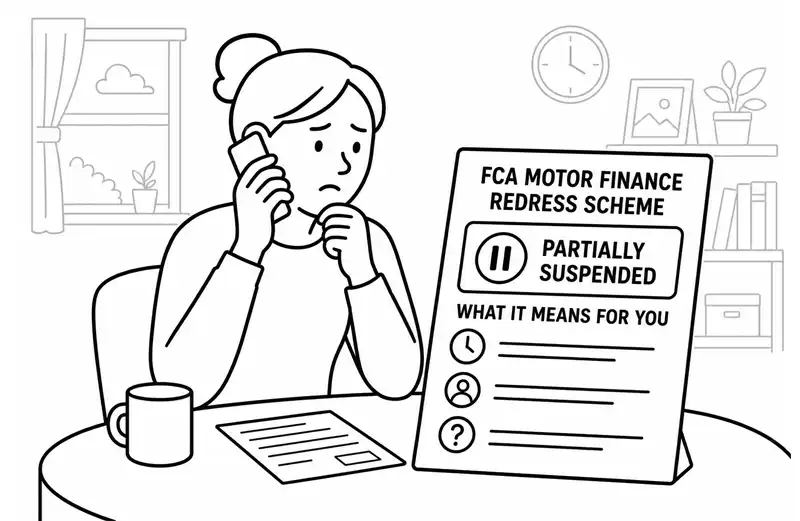
What has happened?
The Upper Tribunal has issued an order partially suspending the Financial Conduct Authority's motor finance redress scheme (PS26/3), following legal challenges brought by four commercial parties: Consumer Voice (represented by Courmacs Legal), Volkswagen Financial Services, Mercedes-Benz Financial Services, and Crédit Agricole Auto Finance.
The Tribunal has confirmed it will hear the challenges in one of two windows — 14 to 18 December 2026, or 16 to 26 February 2027. The final dates depend on any further applications for expert opinion or disclosure by the parties involved.
Until the Tribunal process concludes, key parts of the scheme are on hold.
What does 'partially suspended' actually mean?
The partial suspension is a compromise. It allows firms to keep preparing for the scheme and to progress complaints where they can, while avoiding work that may need to be redone if the legal challenges succeed.
In practice, this means firms are not required to calculate or pay compensation under the scheme, and are not required to send communications about compensation owed, until the Tribunal process ends.
Importantly, the suspension does not apply to everything. Firms must continue to:
- Identify complaints and agreements that fall within the scheme's scope
- Gather the data needed to establish whether discretionary commission, high commission or tied commission arrangements were in place
- Respond to complainants who are not owed compensation under the scheme, by the relevant scheme deadlines (with a limited 7-week extension for firms that need more time)
- Work with claims companies to resolve cases where a consumer is represented by more than one party
- Cooperate fully with the Financial Ombudsman Service on any complaints already referred to it
The FCA has also confirmed that the complaint-handling pause expired on 31 May 2026, so complaints that fall entirely outside the scope of the scheme rules are being progressed in the usual way.
What this means if you have a car finance claim
If you have an active complaint under the scheme, one of three scenarios applies to you:
- You are owed compensation under the scheme. You will not receive payment yet. Firms cannot calculate or pay redress until the Tribunal proceedings conclude. Your lender should keep you informed about the case timetable.
- You are not owed compensation under the scheme. Your lender must still tell you this, by the original scheme deadline — or up to seven weeks later, if they need the additional time the FCA has allowed.
- Your complaint is outside the scope of the scheme. These complaints continue to be handled in the usual way. The suspension does not affect them.
The FCA has said it expects all lenders to keep their complainants updated. It has singled out the three lenders that have challenged the scheme — Volkswagen Financial Services, Mercedes-Benz Financial Services and Crédit Agricole Auto Finance — as needing to contact each of their complainants individually to explain the legal challenge and the resulting delay to any compensation.
Could the scheme be scrapped altogether?
The FCA has been direct on this point. Its central planning assumption is that, in the worst case, the scheme (or parts of it) could be quashed. If that happens, there would be no scheme and no complaints pause — complaints would revert to being handled on a case-by-case basis under the default statutory timelines, largely through the Financial Ombudsman Service.
The regulator has instructed lenders to be operationally and financially ready for that outcome, to make appropriate provisions, and to engage with their auditors. It has said it will supervise firms closely and take action, including imposing business restrictions, against those without the right financial resources in place.
That is a contingency, not a prediction. The FCA has said its scheme is "the quickest, fairest and most efficient way to compensate consumers" and that it will defend the scheme robustly at the Tribunal.
Key dates to remember
- 31 May 2026 — the complaint-handling pause expired. Out-of-scope complaints are being progressed as normal
- 14 to 18 December 2026 or 16 to 26 February 2027 — the Upper Tribunal will hear the legal challenges
- Scheme deadlines + 7 weeks — firms have an additional seven weeks beyond the original scheme deadlines to tell complainants they are not owed compensation, without being treated as non-compliant
What should you do now?
If you had a car finance agreement between 6 April 2007 and 1 November 2024, the practical answer hasn't changed much:
- Identify which agreements you had and which lenders were involved
- Register your complaint if you haven't already — the sooner your lender is on notice, the sooner you will be informed of the outcome
- Watch for updates from your lender about the Tribunal timetable and what it means for your case
Registering an interest costs nothing and keeps you in the queue whichever way the Tribunal rules. If the scheme survives, your claim continues under it. If the scheme is quashed, your complaint reverts to normal handling — either directly with the lender, or through the Financial Ombudsman Service.
The scheme's future is genuinely uncertain right now. But the underlying issue — whether millions of car finance agreements were priced unfairly through discretionary commission — has not gone away, and nor have the routes to challenge them.